
Optimizing your e-commerce conversion funnel: concrete levers that make a difference
Increasing your conversion rate from 1% to 2% means doubling your revenue without spending a single extra euro on advertising. Conversion funnel optimization is the most profitable growth lever in e-commerce. Yet, most online stores settle for an average conversion rate of 1 to 2%, while the best achieve 5 to 8%. The difference? A methodical approach at each stage of the purchasing journey. In this article, we detail the concrete levers that turn your visitors into customers.
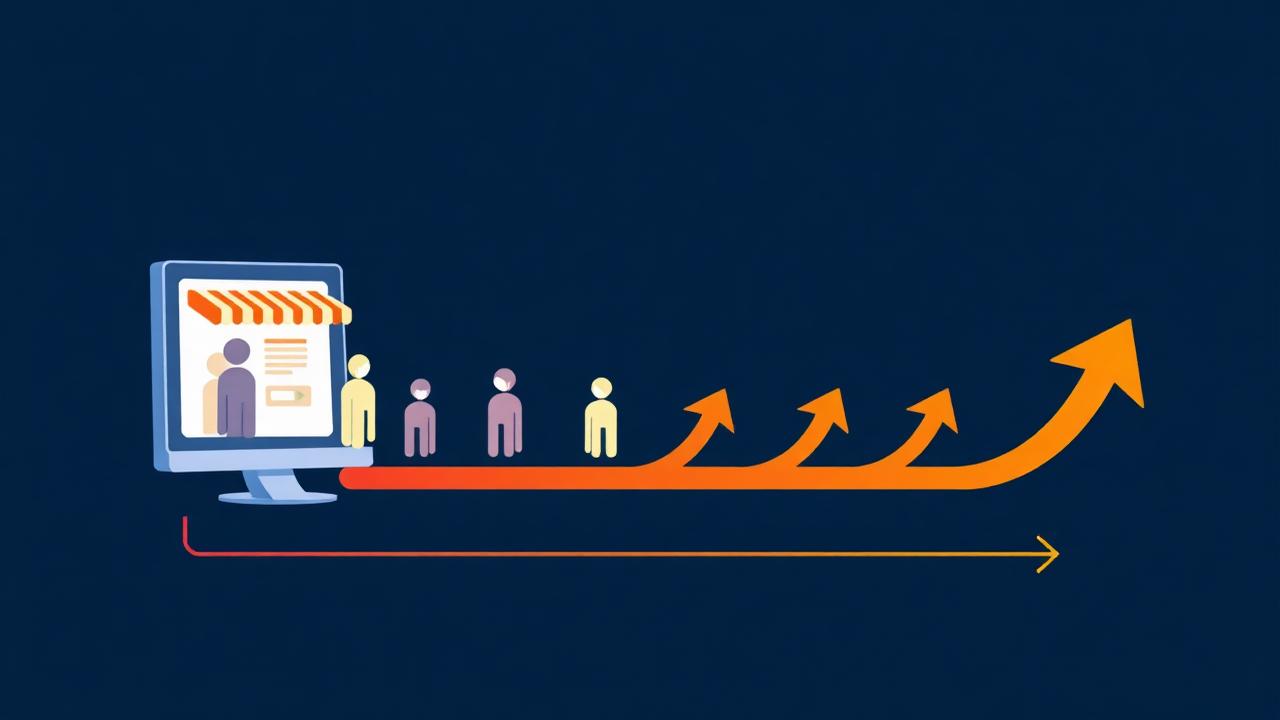
Understanding your conversion funnel
Before optimizing, you need to know where your visitors drop off. Each stage of your funnel has a pass-through rate that can be measured and improved.
Key stages of the funnel
Landing page → Category page → Product listing → Add to cart → Cart → Checkout → Confirmation. At each stage, you lose visitors. The goal is to reduce these losses. Use Google Analytics 4 to create a funnel report and identify the most problematic stages.
Industry benchmarks
Fashion and accessories: 1.5 to 3%. Beauty and cosmetics: 2 to 4%. Food: 3 to 5%. High-tech: 1 to 2.5%. B2B services: 2 to 5%. If your rate is below your industry average, you have a user experience, trust, or pricing problem.
Optimizing your landing pages
First impressions are crucial. On average, you have 5 seconds to convince a visitor to stay.
The value proposition
Your value proposition must be immediately visible: what you sell, to whom, and why from you rather than elsewhere. Avoid vague slogans. Be concrete: "Free delivery in 24h", "Made in France", "30-day money-back guarantee".
Trust signals
From the homepage, reassure your visitors: customer reviews (average rating + number of reviews), secure payment logos, clear return policy, certifications (organic, made in France…), press logos if you've been featured. Trust is built in a few seconds.
Intuitive navigation
Your menu must be clear and structured by logical categories. The search bar must work with autocomplete and typo tolerance. On mobile, the hamburger menu must be thumb-accessible.
Optimizing your product listings
The product listing is the most important page on your site. This is where the purchase decision is made.
Visuals
Professional photos on a white background, in-use photos, product videos if possible, high-resolution zoom. Amazon has shown that each additional image increases the conversion rate by 2 to 5%. Invest in quality visuals: this is the #1 conversion factor in e-commerce.
Product copywriting
Don't just list technical features. Translate each feature into a customer benefit. Instead of "100% organic cotton", write "Soft on your skin and environmentally friendly – 100% certified organic cotton". Structure your descriptions: main benefit first, technical details next, size guide or usage tips as a supplement.
Social proof
Customer reviews are the most powerful conversion lever after price. Display reviews directly on the product listing, with photos and your responses to negative reviews. A product with 10+ reviews converts 2 to 3 times better than a product without reviews.
Reducing cart abandonment
On average, 70% of carts are abandoned in e-commerce. Reducing this rate by a few points has a huge impact on your revenue.
Main causes of abandonment
Shipping costs discovered at checkout (48% of cases). Requirement to create an account (24%). Payment process too long or complex (18%). Lack of trust in payment security (17%). Unclear return policy (12%). Too long delivery times (11%).
Concrete solutions
Display shipping costs from the product listing. Offer guest checkout. Simplify your checkout to a single page if possible. Display payment security logos. Offer multiple payment methods (credit card, PayPal, Apple Pay, 3x payment). Display a clear cart summary with easy modification options.
The re-engagement sequence
Set up an automated email sequence: email 1 after 1 hour (simple reminder), email 2 after 24 hours (with a reassurance argument), email 3 after 72 hours (with an incentive, such as free shipping or a small promo code). This sequence can recover 10 to 15% of abandoned carts.
Optimising checkout and payment in 2026
Checkout has evolved a lot in two years and most stores are not yet taking advantage of it.
Accelerated wallets
Shop Pay, Apple Pay, Google Pay and PayPal pre-fill address and payment: a recognised customer completes in seconds. On Shopify, Shop Pay shows conversion rates well above the classic checkout. Make sure these buttons appear from the product page and cart, not only at the last step.
Split payment
Paying in 3 or 4 instalments (Alma, Klarna, PayPal Pay in 4) removes the amount barrier on baskets above €100. Display the instalment directly on the product page. The cost to you (a few percent) is generally offset by the increase in average basket and conversion rate.
Address and delivery
Address autocomplete, pickup point selection on a map, estimated delivery date shown before payment: every uncertainty removed reduces abandonment. If you sell across Europe, show prices including tax in the customer's currency and any customs duties before payment, never after.
Optimizing the mobile experience
More than 65% of e-commerce traffic is mobile in France. If your mobile site is not impeccable, you lose the majority of your visitors.
Mobile fundamentals
Sufficiently large action buttons (minimum 48px). Simplified forms with autocomplete. Keyboard adapted to the field type (numeric for phone, email for address). Sticky add-to-cart always visible. One-click payment (Apple Pay, Google Pay). Loading in less than 3 seconds on 4G.
Test on real devices
Don't just rely on your browser's responsive mode. Test your purchasing journey on real smartphones (iPhone and Android). Ask friends and family to place a test order and observe their difficulties. Mobile usability issues are often invisible on a desktop screen.
AI in service of conversion: what really works
AI tools applied to conversion have multiplied. Some bring measurable gains, others harm the experience. Semantic search (understanding "gift for a cyclist" rather than exact words) and personalised recommendations improve product discovery, especially on wide catalogues. On-site conversational assistants can help if their answers are grounded in your real data (stock, lead times, return policy) and if they hand over to a human without friction; a chatbot that makes up an answer costs more than it returns. AI-assisted product copywriting speeds up production, provided a human checks the specifications. Finally, always test the impact on load time: a heavy AI widget can cancel its own gains. A digital marketing audit and strategy helps prioritise these projects according to your traffic and margins.
Measure and iterate continuously
Conversion optimization is never finished. It's a continuous process of testing, measuring, and improving.
KPIs to track
Overall conversion rate and by funnel stage. Cart abandonment rate. Average order value. Bounce rate per page. Time spent on product listings. Customer return rate. Track these metrics weekly and identify trends.
A/B testing
Test one variable at a time: buy button text, CTA color, review position, product listing layout. Use tools like AB Tasty, VWO or Convert (Google Optimize was discontinued in 2023) or AB Tasty. One test per week for 3 months can increase your conversion rate by 20 to 50%.
Key takeaways
- Identify friction points with GA4 before optimizing
- Product visuals are the #1 conversion factor
- Display shipping costs from the product listing
- Simplify checkout and offer guest checkout
- A re-engagement sequence recovers 10-15% of abandoned carts
- Test and iterate continuously with A/B testing
Checklist
- Funnel report configured in GA4
- Shipping costs displayed before checkout
- Guest checkout enabled
- One-page checkout or minimum steps
- Professional product photos (min. 4 per product)
- Customer reviews displayed on product listings
- Abandoned cart email sequence active
- Site tested on mobile with real devices
- A/B test in progress on at least one element
Frequently asked questions
What conversion rate should I aim for?
How long does it take to see results?
Should I invest in a paid A/B testing tool?
How do I measure the conversion funnel in GA4 in 2026?
Need to improve your conversion rate?
We audit your purchasing journey and identify the most impactful optimization levers for your store.
Request an audit